Inversion
An architectural concept where the control flow of a program, including object creation, initialization, and execution, is handled by an external system (a container) rather than being directly managed by the developer.
- The concept of IoC is frequently encountered in frameworks.
- IoC ⇒ When using this principle, instead of allowing the app to control the execution, we give control to the Spring Framework
- diagram
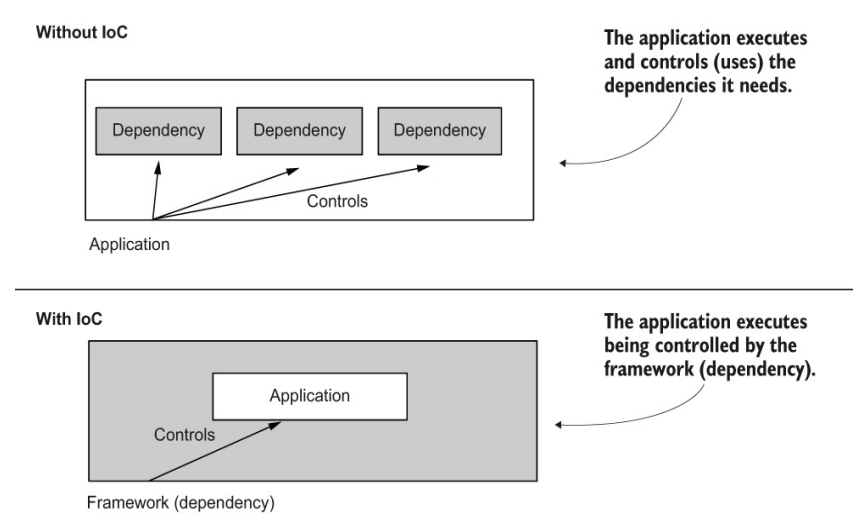
IoC in Spring Framework
IoC is a design principle, and frameworks like Spring are built on top of this principle.
- The Spring Framework’s IoC container is what performs the “inversion.”
- It’s the central part of Spring that takes over the responsibility of creating your objects, configuring them, and injecting their dependencies.
- Spring dictates the “flow”
- You provide components and the framework decides when and how to instantiate & connect them
- Basically you give up the right to use the keyword
new - You simply tell Spring (via configuration): “Hey, I need a
UserService.” Spring’s reaction: “Okay, I seeUserServiceneeds aUserRepository. I will create the repository, I will create the service, I will connect them, and I will have them ready for you.”
Without IoC
// Repository
public class MemberRepository {
    public String findMemberName(Long id) {
        return "김스프링";
    }
}

// Service
public class MemberService {
    private MemberRepository memberRepository;

    public MemberService() {
        // Directly creating the dependent object -> tight coupling
        this.memberRepository = new MemberRepository();
    }

    public String getMemberName(Long id) {
        return memberRepository.findMemberName(id);
    }
}

// Controller
public class MemberController {
    private MemberService memberService;

    public MemberController() {
        // Directly creating the dependent object -> tight coupling
        this.memberService = new MemberService();
    }

    public void printMember(Long id) {
        String name = memberService.getMemberName(id);
        System.out.println("회원 이름: " + name);
    }
}- The developer is in control
- The developer explicitly writes
new MemberRepository()andnew MemberService(). They are manually managing the creation and dependencies.
- The developer explicitly writes
- Strong coupling
- Each object explicitly depends on the concrete implementation of the object it uses.
- If
MemberRepositorychanges its constructor (maybe we changed it to need parameters),MemberServicewould also need to be updated. - If you wanted to use a different
MemberRepositoryimplementation for testing, you’d have to change theMemberServicecode. (hard to swap for mock)
With IoC
// Repository
@Repository
public class MemberRepository {
    public String findMemberName(Long id) {
        return "김스프링";
    }
}

// Service
@Service
public class MemberService {
    private final MemberRepository memberRepository;

    // Spring automatically (and externally) injects + constructor injection -> advantageous for testing and extension
    @Autowired
    public MemberService(MemberRepository memberRepository) {
        this.memberRepository = memberRepository;
    }

    public String getMemberName(Long id) {
        return memberRepository.findMemberName(id);
    }
}

// Controller
@RestController
public class MemberController {
    private final MemberService memberService;

    // Spring automatically (and externally) injects + constructor injection -> advantageous for testing and extension
    @Autowired
    public MemberController(MemberService memberService) {
        this.memberService = memberService;
    }

    @GetMapping("/members/{id}")
    public String getMember(@PathVariable Long id) {
        return memberService.getMemberName(id);
    }
}- Developers simply define roles (interfaces) and provide configuration information (annotations or settings), and Spring then handles the entire control flow.
- With IoC, control over objects is delegated to a container. This means the framework (like Spring) takes on the role of creating and managing objects and connecting dependent objects.
IoC Container (aka. Spring Context)
IoC
Refers to a concrete framework that implements Inversion of Control.
- A central management unit that creates objects (Beans) used in an application, injects dependencies, and manages their lifecycle
- Using an IoC Container allows for the automatic creation, initialization, and dependency handling of objects.
- A prime example of an IoC Container is Spring Framework’s
ApplicationContext.
- Spring provides various IoC Container implementations, but the most commonly used one is
ApplicationContext(andBeanFactory). - The main role of the Spring IoC Container is to manage the entire lifecycle of Bean objects, from creation, management, and configuration to destruction.
- Using the IoC container, to which you often refer as the Spring context, you make certain objects known to Spring, which enables the framework to use them in the way you configured
ApplicationContext
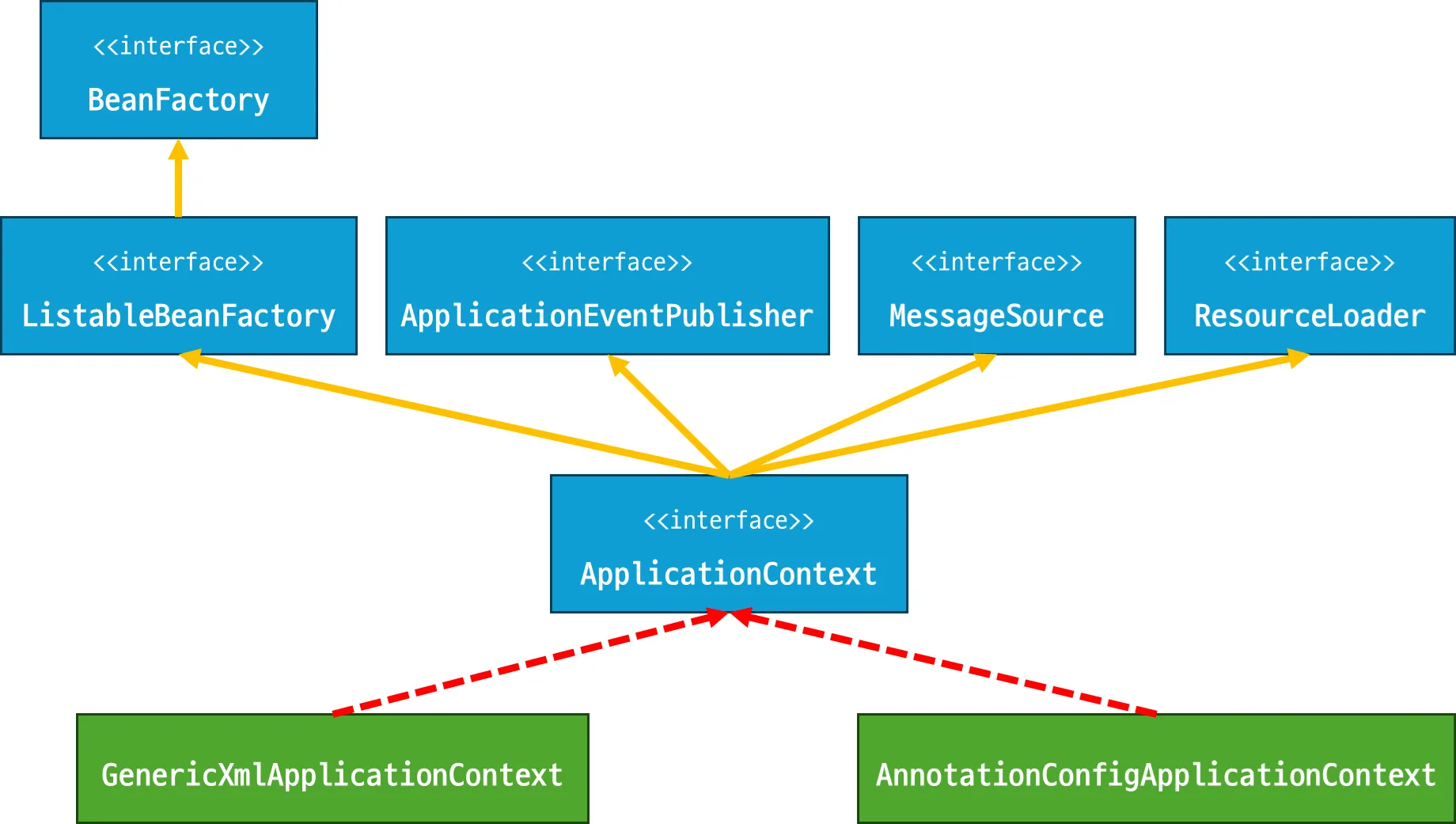
ApplicationContext
A core IoC Container implementation in Spring, extending
BeanFactory
BeanFactory’s ability to register and manage beans + numerous additional features offered by Spring- This is why
ApplicationContextis the most commonly used in real-world applications- It’s an interface
- It adds the following functionalities:
ListableBeanFactory: Includes all the capabilities provided byBeanFactory.ApplicationEventPublisher: Provides event handling capabilities.MessageSource: Supports internationalization (i18n) by resolving messages.ResourceLoader: Provides resource handling capabilities.- AOP integration
- BeanPostProcessor (Bean Post-processor) support
- Automatic Bean registration support (e.g., through component scanning)
Implementations
| 구현체 이름 | 설명 | 특징 |
|---|---|---|
AnnotationConfigApplicationContext | Java 기반 설정용 - reads Java-based Configuration Metadata to perform its container role | @Configuration 클래스 기반 |
GenericWebApplicationContext | Spring Web 환경용 - reads XML-based Configuration Metadata to perform its container role - deprecated lol | Spring MVC 및 Boot의 기반 |
WebApplicationContext | Spring MVC의 특수 컨텍스트 | DispatcherServlet과 연계 |
ClassPathXmlApplicationContext | XML 설정용 | 과거 버전과 호환, 지금은 잘 안 씀 |
ConfigurableApplicationContext | (sprint과제 때 사용) |
ApplicationContext context = new AnnotationConfigApplicationContext(AppConfig.class);

MyService service = context.getBean(MyService.class);- You can use
.getBean()to inspect specific bean, but this violates IoC (Inversion of Control), DI (Dependency Injection) , and DIP so we don’t use it- we need to be able to use the bean without knowing its name
- but if we use
getBean()we need to know the bean - we can use getBean through:
- its type (
UserService.class) - By its name (less common when you have an interface and a single implementation, but possible).
After
refresh(), its state can be inspected through the following key fields:
- its type (
| Item | Description |
|---|---|
beanFactory | The core object responsible for Bean creation and dependency injection. |
environment | Contains environmental information, such as active profiles and configuration values. |
applicationListeners | A list of registered application event listeners. |
messageSource | Provides message resources for internationalization (i18n). |
lifecycleProcessor | A component that manages the application’s startup and shutdown. |
BeanFactory
The most fundamental interface in Spring’s IoC Container hierarchy
- Provides only the minimal functionality to create and return beans
- Was used in early Spring versions but is rarely used now
- Supports lazy initialization (lazy loading)
- this is a key difference from
ApplicationContext - 생성시점, 초기화 시점이 나눠짐
- this is a key difference from
- Centered around explicit Bean lookup via
getBean()method. - bean 최소 기능 명세만 제공 (interface니까)
Configuration Metadata
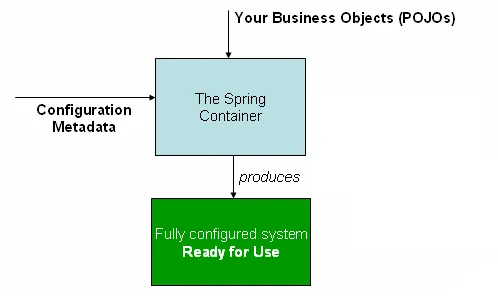
- Refers to the configuration information that tells the IoC Container which objects to create, how to create them, and which dependencies to inject.
- Think of it as the “work instruction manual” for the IoC Container, detailing what work it needs to do and how to do it
- Three ways to provide this Configuration Metadata:
- (While Java Config is effectively the standard, in practice, a hybrid approach combining Java Config with Annotation-based configuration is widely used.)
| Method | Recommendation | Description |
|---|---|---|
| XML-based | ❌ Discouraged | Explicit but cumbersome and lacks type safety. |
Java Config (@Configuration) | ✅Recommended | Explicit, ensures type safety, and is the default for Spring Boot. |
Annotation-based (@Component) | ✅Recommended (as supplement) | Effective when used in conjunction with Java Config. |
Object Lifecycle Management
Bean Lifecycle Phases
The IoC container doesn’t just create objects; it manages the entire lifecycle of each object.
- Allows devs to focus on core business logic without intervening in the object’s creation, initialization, or destruction.
- Loading Bean Definitions
- The container reads metadata for each bean from Spring configuration files (XML or annotation-based). This information includes the class type, dependencies, initialization methods, and all other details necessary for bean configuration.
- Object Instance Creation
- The bean class object is instantiated using the
newkeyword. Dependency injection has not yet occurred at this stage.
- The bean class object is instantiated using the
- Dependency Injection
- The container injects other beans that the current bean requires.
- Various injection methods can be configured, such as constructor, setter, or field-based injection.
- Initialization Callbacks Execution
- Bean initialization logic can be defined and executed in the following ways:
- Methods annotated with
@PostConstruct. - The
afterPropertiesSet()method of theInitializingBeaninterface. - XML configuration using the
<bean init-method="..." />attribute.
- Methods annotated with
- Bean initialization logic can be defined and executed in the following ways:
- In Use
- Once initialized, the bean is managed by the container and can be freely used within the application logic.
- From this point, the bean, with its dependencies injected, performs its actual business functionality.
- Destruction Callbacks Execution
- These methods are called before the container shuts down or the bean is destroyed, allowing for resource cleanup or other pre-shutdown tasks:
- Methods annotated with
@PreDestroy. - The
destroy()method of theDisposableBeaninterface. - XML configuration using the
<bean destroy-method="..." />attribute.
- Methods annotated with
- These methods are called before the container shuts down or the bean is destroyed, allowing for resource cleanup or other pre-shutdown tasks: