Dependency
Dependeny
Refers to the relationship that arises when one object uses another. >
public class OrderService {

    // 의존하고 있는 PaymentProcessor 객체를 직접 생성
    private PaymentProcessor paymentProcessor = new PaymentProcessor();
}- Ex) If an
OrderServiceuses aPaymentProcessor, we say thatOrderServicedepends onPaymentProcessor. - Tight coupling
- Object is directly created leads to tight coupling
- It’s difficult to change implementations or use substitute objects (Mocks) for testing
Dependency Injection
Dependency
Instead of an object creating its own dependencies, its dependencies are given to it from the outside.
- A specific technique (a design pattern) that implements the Inversion of Control (IoC) principle.
Without DI
public class MenuController {
	public static void(String[] args) {
		MenuService menuService = new MenuService();
		List<Menu> menuList = menuService.getMenuList();
	}
}

//
public class MenuService {
	public List<Menu> getMenuList() {
		return null;
	}
}- There is a dependency relationship established because the
MenuControllerclass creates and references another class object
With DI
public class CafeClient {
	public static void main(String[] args) {
		MenuService menuService = new MenuService();
		MenuController controller = new MenuController(menuService); //
		List<Menu> menuList = menuService.getMenuList();
	}
}
public class MenuController {
	private MenuService menuService;

	/// HERE<<<<
	public MenuController(MenuService menuService) {
		this.menuService = menuService;
	}

	public List<Menu> getMenus() {
		return menuService.getMenuList();
	}

}MenuControllerreceives theMenuServiceobject through its constructor- This is DI - passing an object as a constructor parameter = injecting an object from an external source (
CafeClient) CafeClient(the external source) passesmenuServiceas a constructor parameter
- This is DI - passing an object as a constructor parameter = injecting an object from an external source (
Loose coupling
DI AVOIDS TIGHT COUPLING
- Tight coupling
- When you use the
newkeyword inside a class to create an object it depends on, you create a strong, direct link (tight coupling) to a specific implementation of that object. - U need to change all parts of the code that uses it if u edit the class
- When you use the
- Loose coupling
- DI allows loose coupling, which allows you to easily substitute different implementations (e.g., a real one for production, a stub for testing) without ever changing the dependent class’s internal code.
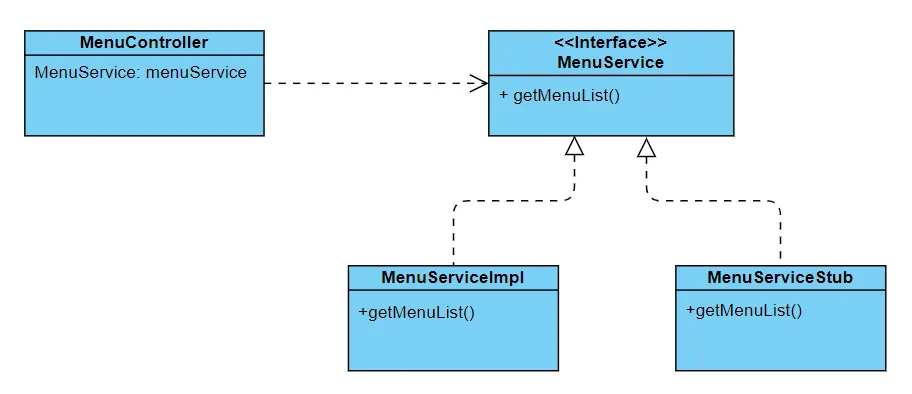
MenuControllerdepends only on theMenuServiceinterface.- The concrete implementations (
MenuServiceImpl,MenuServiceStub) are injected at runtime.
In Spring
- The Spring Framework’s container streamlines dependency injection by handling object creation and injection on your behalf.
- Uses annotations like
@Component,@Service,@Repositoryfor automatic component scanning where Spring directly instantiates and manages objects. - Uses
@Configurationand@Beanmethods when you want to explicitly define how an object is created and configured within Spring’s container.
- Uses annotations like
@Configuration
public class Config {

    @Bean
    public MenuService menuService() {
        return new MenuServiceStub();
    }

    @Bean
    public MenuController menuController() {
        return new MenuController(menuService());
    }
}- Spring uses the container to manage the
MenuServiceStubinstance (created by themenuService()method) as a Bean. - When creating the
menuControllerBean, Spring supplies the managedMenuServiceStubinstance as theMenuServicedependency toMenuController’s constructor.**
Ways to do it
| Method | Description | Recommendation |
|---|---|---|
| ⭐ Constructor Injection | Injects via the constructor | ✅ Most Recommended |
| Field Injection | Injects via fields | ❌ Not Recommended (for testing/immutability) |
| Setter Injection | Injects via setter methods | ⚠️ Use for optional dependency injection |
Constructor Injection
- Constructor Injection is the most recommended
public class OrderService {

    private final PaymentProcessor paymentProcessor;

    // 생성자 주입
    @Autowired
    public OrderService(PaymentProcessor paymentProcessor) {
        this.paymentProcessor = paymentProcessor;
    }
}- Advantage: You can use the
finalkeyword- Means that you can guarantee that it will NEVER be
null!! (you can avoidNullPointerException)
- Means that you can guarantee that it will NEVER be
- When you have 2 or more constructors, you must use the
@Autowiredannotation on top of the constructor
Field Injection
public class OrderService {

    // Field Injection - Not recommended for critical dependencies
    @Autowired
    private PaymentProcessor paymentProcessor;

    // No constructor needed to inject PaymentProcessor

    // ... other methods using paymentProcessor
}- Not recommended
- You CANNOT use
finalkeyword, there is a chance of it beingnulland causingNullPointerException - It relies on reflection (a Spring mechanism) to set the field, which can make testing harder as you can’t easily instantiate the object without Spring’s container.
Setter Injection
public class OrderService {

    private PaymentProcessor paymentProcessor;

    // Setter Injection
    @Autowired
    public void setPaymentProcessor(PaymentProcessor paymentProcessor) {
        this.paymentProcessor = paymentProcessor;
    }

    // ... other methods using paymentProcessor
}- When to Use: It’s useful for optional dependencies or for dependencies that might change during the object’s lifecycle (though this is less common in typical Spring applications).
- Also not recommended for similar reasons like the field injection above
Dependency in Gradle
The project has dependencies to other libraries/modules
- Your software project isn’t built from scratch in isolation. Instead, it relies on, or depends on, pre-written code or functionalities provided by other separate pieces of software
- Gradle - Dependency configuration