Chain
A sequence of calls (ex. LLM, tool, data processing, etc) linked together to accomplish a complex tast
- Most important concept in Langchain
Warning
2/27/26 - THIS METHOD IS OUTDATED! We use LCEL (LangChain Expression Language). Just learn this to get the underlying concepts.
LLMChain
- Combination of the LLM and the prompt
- most basic type of chain
from langchain.chat_models import ChatOpenAI
from langchain.prompts import ChatPromptTemplate
from langchain.chains import LLMChain

llm = ChatOpenAi(temperature=0.9, model=llm_model)

prompt = ChatPromptTemplate.from_template(
    "What is the best name to describe \
    a company that makes {product}?"
)
chain = LLMChain(llm=llm, prompt=prompt)
product = "cake"
chain.run(product) # "Sweet Delights Bakery"
Sequential Chains
- combines multiple chains where the output of the one chain is the input of the next chain
- two types
SimpleSequentialChain- single input/outputSequentialChain- multiple inputs/outputs
SimpleSequentialChain
from langchain.chains import SimpleSequentialChain

llm = ChatOpenAI(temperature=0.9, model=llm_model)

# prompt template 1
first_prompt = ChatPromptTemplate.from_template(
    "What is the best name to describe \
    a company that makes {product}?"
)
# Chain 1
chain_one = LLMChain(llm=llm, prompt=first_prompt)

# prompt template 2
second_prompt = ChatPromptTemplate.from_template(
    "Write a 20 words description for the following \
    company:{company_name}"
)
# chain 2
chain_two = LLMChain(llm=llm, prompt=second_prompt)

overall_simple_chain = SimpleSequentialChain(chains=[chain_one, chain_two], verbose=True)

overall_simple_chain.run(product)
SequentialChain
from langchain.chains import SequentialChain

llm = ChatOpenAI(temperature=0.9, model=llm_model)- chain 1: translate non-eng review to english
# prompt template 1: translate to english
first_prompt = ChatPromptTemplate.from_template(
    "Translate the following review to english:"
    "\n\n{Review}"
)
# chain 1: input= Review and output= English_Review
chain_one = LLMChain(llm=llm, prompt=first_prompt,
                     output_key="English_Review"
                    )
- chain 2: summarize review in 1 sentence
second_prompt = ChatPromptTemplate.from_template(
    "Can you summarize the following review in 1 sentence:"
    "\n\n{English_Review}"
)
# chain 2: input= English_Review and output= summary
chain_two = LLMChain(llm=llm, prompt=second_prompt,
                     output_key="summary"
)- chain 3: ask which language is the original review
# prompt template 3: translate to english
third_prompt = ChatPromptTemplate.from_template(
    "What language is the following review:\n\n{Review}"
)
# chain 3: input= Review and output= language
chain_three = LLMChain(llm=llm, prompt=third_prompt,
                       output_key="language"
)- chain 4: follow up message to the summary in the original language
# prompt template 4: follow up message
fourth_prompt = ChatPromptTemplate.from_template(
    "Write a follow up response to the following "
    "summary in the specified language:"
    "\n\nSummary: {summary}\n\nLanguage: {language}"
)
# chain 4: input= summary, language and output= followup_message
chain_four = LLMChain(llm=llm, prompt=fourth_prompt,
                      output_key="followup_message"
                     )
overall chain + execution!!
# overall_chain: input= Review
# and output= English_Review,summary, followup_message
overall_chain = SequentialChain(
    chains=[chain_one, chain_two, chain_three, chain_four],
    input_variables=["Review"],
    output_variables=["English_Review", "summary","followup_message"],
    verbose=True
)
review = df.Review[5]
overall_chain(review)
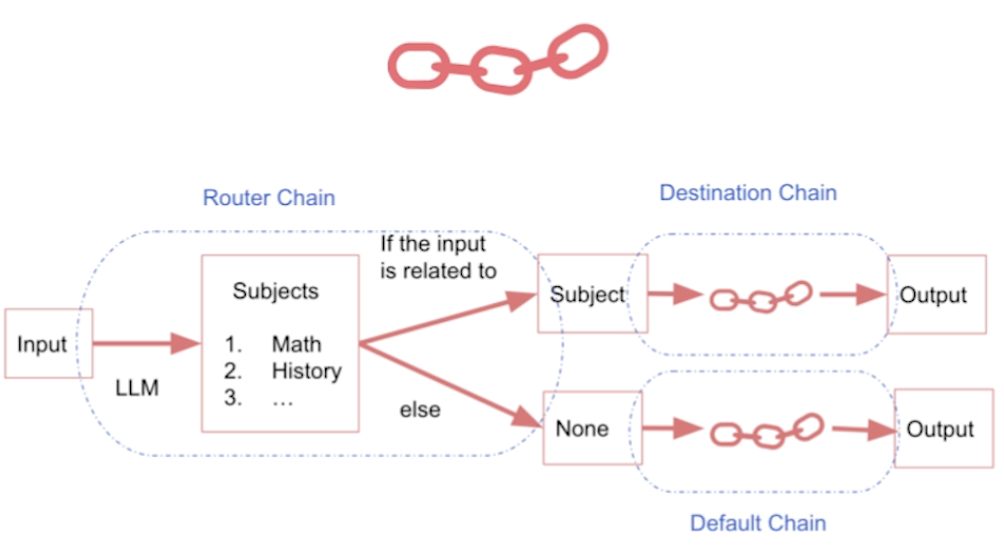
Router Chain
-
you route an input to the chain based on what input it is
-
diagram
-
templates
math_template = """You are a very good mathematician. \
You are great at answering math questions. \
You are so good because you are able to break down \
hard problems into their component parts,
answer the component parts, and then put them together\
to answer the broader question.

Here is a question:
{input}"""

history_template = """You are a very good historian. \
You have an excellent knowledge of and understanding of people,\
events and contexts from a range of historical periods. \
You have the ability to think, reflect, debate, discuss and \
evaluate the past. You have a respect for historical evidence\
and the ability to make use of it to support your explanations \
and judgements.

Here is a question:
{input}"""
prompt_infos = [
{
"name": "math",
"description": "Good for answering math questions",
"prompt_template": math_template
},
{
"name": "History",
"description": "Good for answering history questions",
"prompt_template": history_template
}
]from langchain.chains.router import MultiPromptChain
from langchain.chains.router.llm_router import LLMRouterChain,RouterOutputParser
from langchain.prompts import PromptTemplate
llm = ChatOpenAI(temperature=0, model=llm_model)
destination_chains = {}
for p_info in prompt_infos:
name = p_info["name"]
prompt_template = p_info["prompt_template"]
prompt = ChatPromptTemplate.from_template(template=prompt_template)
chain = LLMChain(llm=llm, prompt=prompt)
destination_chains[name] = chain
destinations = [f"{p['name']}: {p['description']}" for p in prompt_infos]
destinations_str = "\n".join(destinations)
default_prompt = ChatPromptTemplate.from_template("{input}")
default_chain = LLMChain(llm=llm, prompt=default_prompt)
default_chain- the chain used when the router can’t decide which chain to use
MULTI_PROMPT_ROUTER_TEMPLATE = """Given a raw text input to a \
language model select the model prompt best suited for the input. \
You will be given the names of the available prompts and a \
description of what the prompt is best suited for. \
You may also revise the original input if you think that revising\
it will ultimately lead to a better response from the language model.

<< FORMATTING >>
Return a markdown code snippet with a JSON object formatted to look like:
```json
{{{{
    "destination": string \ "DEFAULT" or name of the prompt to use in {destinations}
    "next_inputs": string \ a potentially modified version of the original input
}}}}```

REMEMBER: The value of “destination” MUST match one of \
the candidate prompts listed below.\
If “destination” does not fit any of the specified prompts, set it to “DEFAULT.”
REMEMBER: "next_inputs" can just be the original input \
if you don't think any modifications are needed.

<< CANDIDATE PROMPTS >>
{destinations}

<< INPUT >>
{{input}}

<< OUTPUT (remember to include the ```json)>>"""
router_template = MULTI_PROMPT_ROUTER_TEMPLATE.format(
destinations=destinations_str
)
router_prompt = PromptTemplate(
template=router_template,
input_variables=["input"],
output_parser=RouterOutputParser(),
)
router_chain = LLMRouterChain.from_llm(llm, router_prompt)
chain = MultiPromptChain(router_chain=router_chain,
destination_chains=destination_chains,
default_chain=default_chain, verbose=True
)router_template- we create this by using the destinations above