cons - bad for multiple receivers, high coupling, client/server have to be always running
the pub/sub model
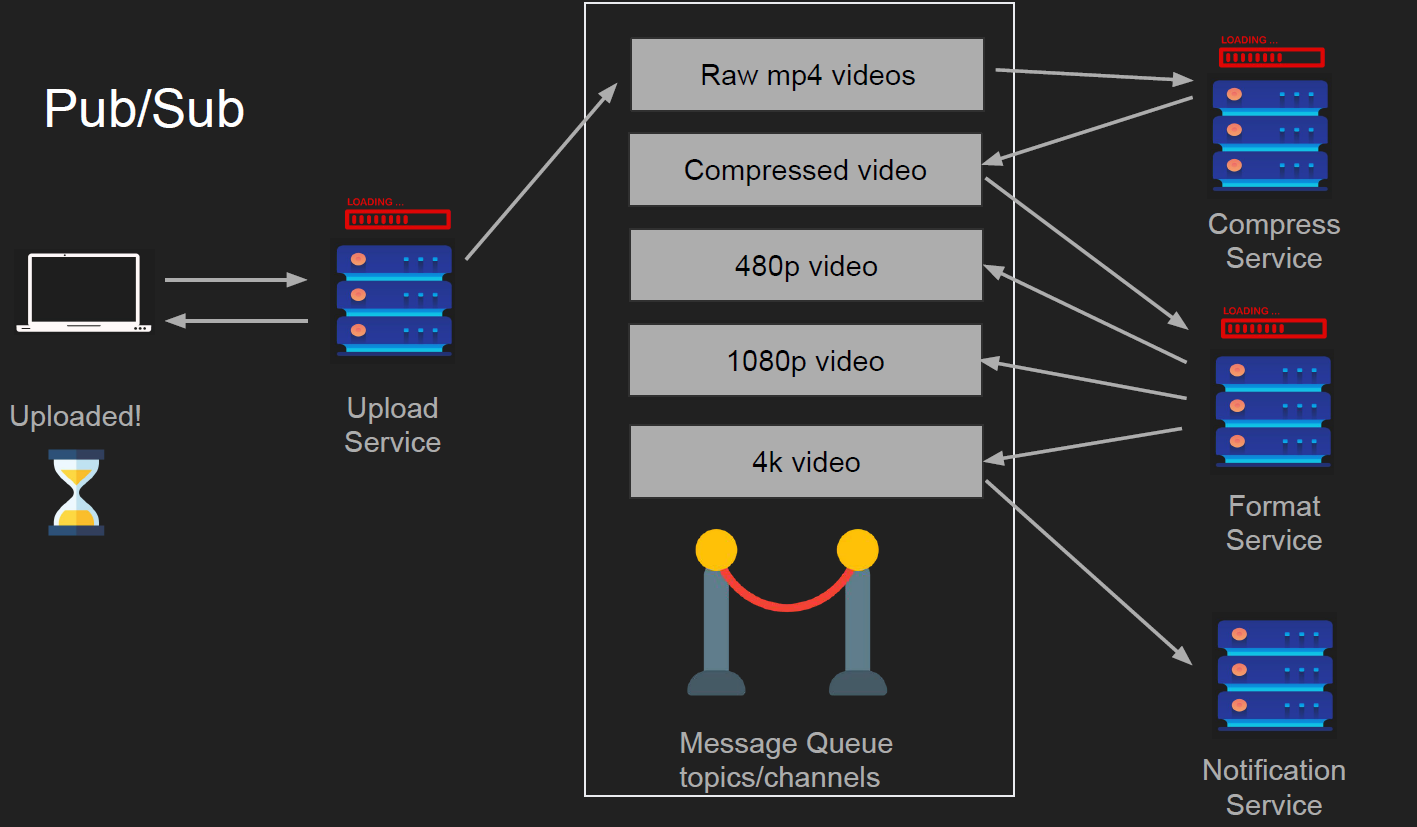
this diagram
shows a chain of Pub/Sub relationships (often called an “Event-Driven Architecture” or a “Pipeline”), rather than just one single publisher and one single subscriber
components don’t talk to each other directly (e.g., The Upload Service doesn’t call the Compress Service). Instead, they talk to a “middleman” (the Topic/Queue)
what is happening (gemini explained)
The Publishers (Producers):
The Upload Service publishes a message: “Hey, a new raw video is ready!” into the “Raw mp4 videos” topic.
The Compress Service acts as a publisher too! After it finishes its job, it publishes a message: “Hey, the video is now compressed!” into the “Compressed video” topic.
The Topics (Channels):
The gray boxes in the middle (“Raw mp4 videos”, “Compressed video”, etc.) are the topics. They hold the messages until someone is ready to pick them up.
The Subscribers (Consumers):
The Compress Service subscribes to the “Raw mp4 videos” topic. It sits there waiting for a message to arrive.
The Format Service subscribes to the “Compressed video” topic.
The Notification Service subscribes to the final topics (likely “4k video” or all processed topics) so it knows when to email the user.
pros
scales with multiple receivers
great or microservices
loose coupling
works while client is not running
cons
message delivery issues (how do i know the consumer/subscriber actually got the message?)