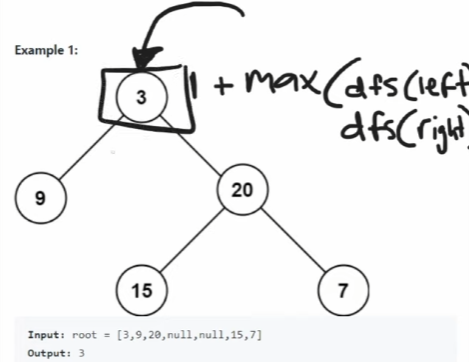
ohhhh man i am in great danger i need to get good at this (and this is even an easy question am i cooked)
also switching to python for an upcoming python interview
solution 1 - dfs (recursion)
class Solution:
    def maxDepth(self, root: Optional[TreeNode]) -> int:
        if not root:
            return 0
        return 1 + max(self.maxDepth(root.left), self.maxDepth(root.right))
we look at the max of both subtrees
solution 2 - dfs (iteration)
class Solution:
    def maxDepth(self, root: Optional[TreeNode]) -> int:
        stack = [[root, 1]]
        res = 0

        while stack:
            node, depth = stack.pop()

            if node:
                res = max(res, depth)
                stack.append([node.left, depth + 1])
                stack.append([node.right, depth + 1])
        return res
using a stack
solution 3 - bfs (iteration)
class Solution:
    def maxDepth(self, root: Optional[TreeNode]) -> int:
        if not root: return 0
        q = deque([root])

        height = 0
        while q:
            for i in range(len(q)): # iterating by level
                node = q.popleft()
                if node.left: q.append(node.left)
                if node.right: q.append(node.right)
            height += 1
        return height
my initial idea + attempt
basically
the for loop in the middle - pull everything out in the queue (per level)
u have to use range(len(q) to hardcode (takes snapshot of len(q) at that time) → we have to do this because q is changing