You are given an array of integers nums containing n + 1 integers. Each integer in nums is in the range [1, n] inclusive.
Every integer appears exactly once, except for one integer which appears two or more times. Return the integer that appears more than once.
solution (floyds cycle detection)
concept
- If you have an array, you can have each of the value of the array be a pointer that points to another index.
- Since each number is in the range
[1,n]inclusive, we can be certain that the cycle will never be on the 0th index because no element can be 0 (and we’re using the values as indices). - Then, we can use slow/fast pointer to detect if there is a cycle.
- Example:
[1,2,3,1]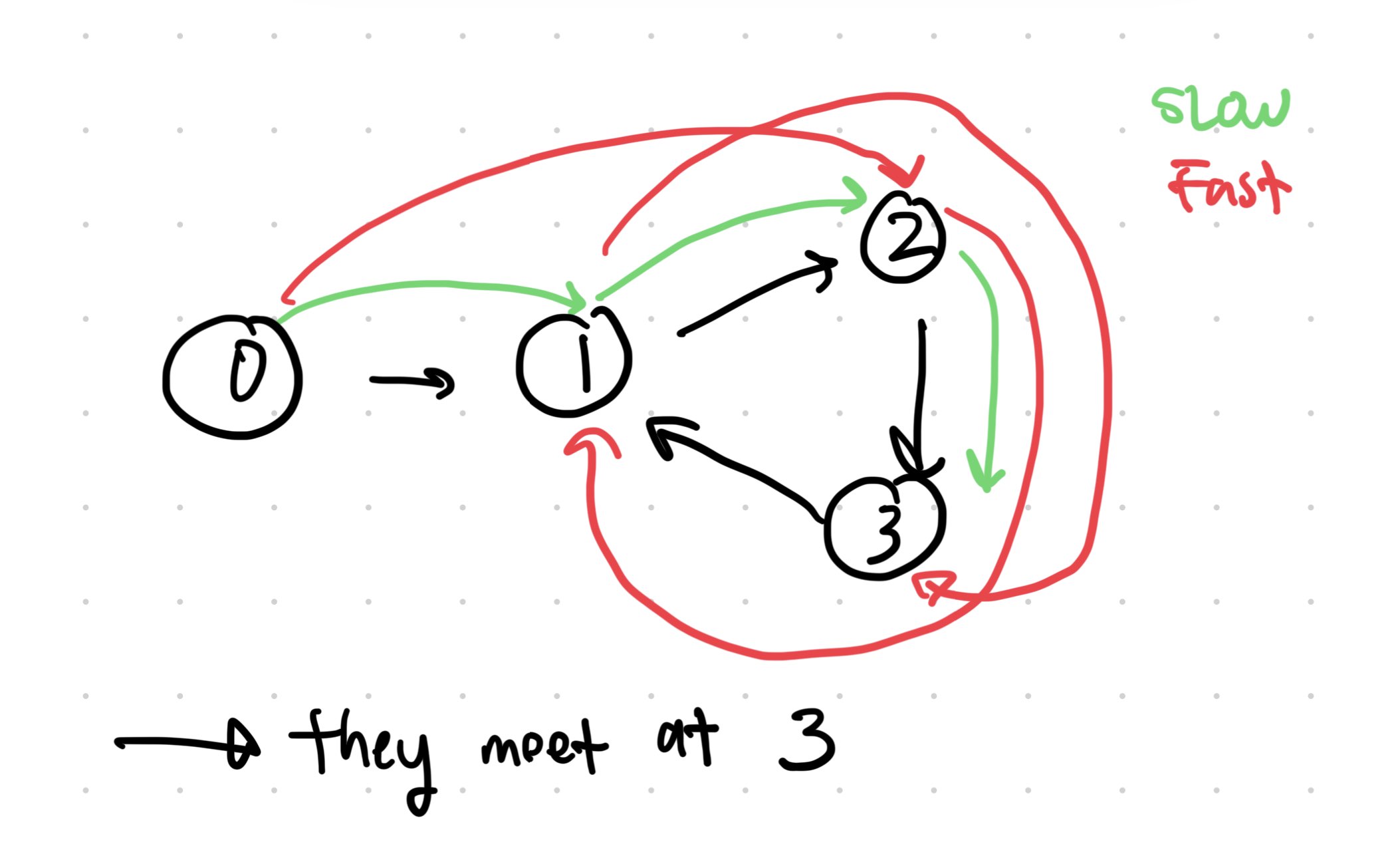 - The intersection of the slow/right pointers is 3. We leave the fast pointer at that intersection.
 - Now, can see that
p = x.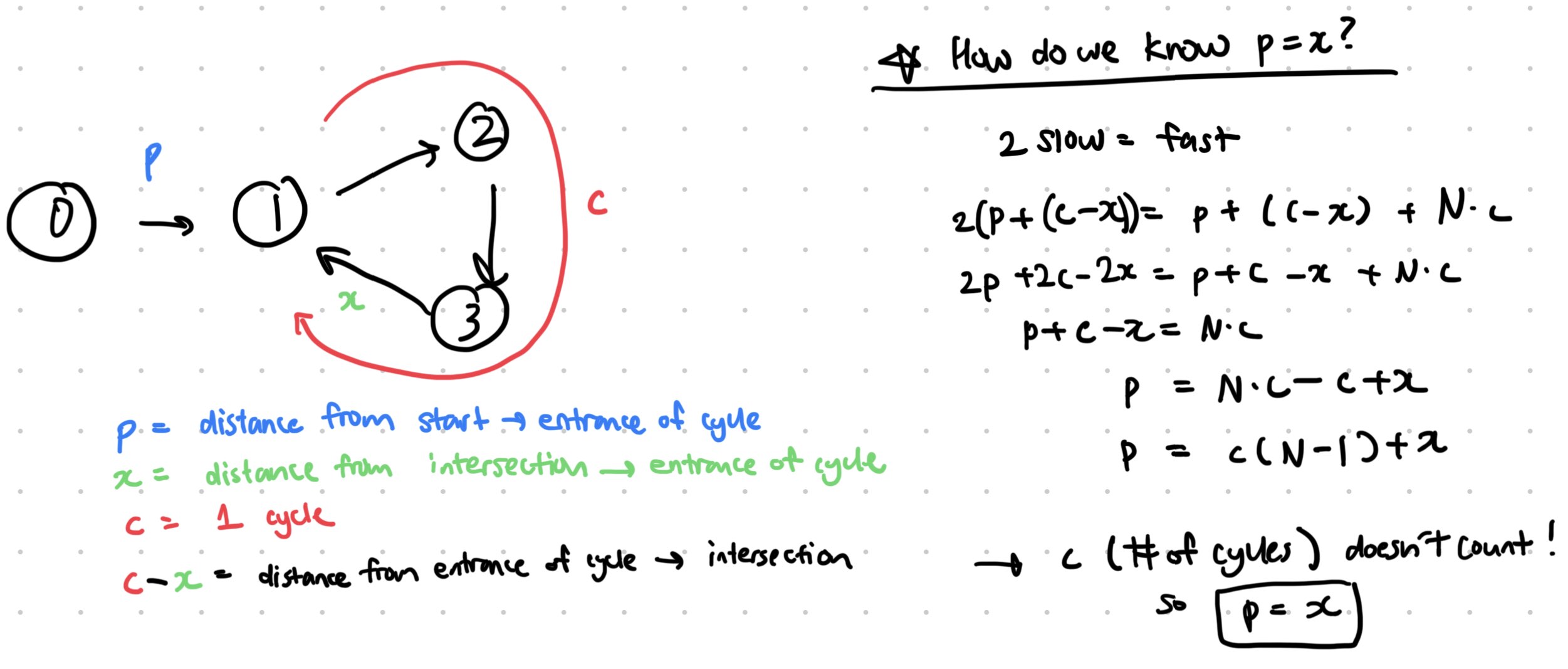
- NOTE:
N * cwhereNis any integer >= 1. - This is because for you to have a cycle, the fast pointer MUST have done at least 1 extra lap to meet the 2nd pointer
- NOTE:
- From here, we assign one pointer back to start,
slow2. So we have 1 pointer at the start (slow2), and the slow pointer we left at the intersection (slow). - Then, we can keep moving these 2 pointers by 1 until they intersect, and that will be the start of the cycle.
code
class Solution {
    public int findDuplicate(int[] nums) {
        int slow = 0;
        int fast = 0;

        // finding intersection
        while (true) {
            slow = nums[slow];
            fast = nums[nums[fast]];
            if (slow == fast) {
                break;
            }
        }

        // reducing p and x to get start of cycle
        int slow2 = 0;
        while (true) {
            slow = nums[slow];
            slow2 = nums[slow2];
            if (slow == slow2) {
                return slow;
            }
        }
    }
}
time complexity
- 1st phase (finding intersection)
- slow pointer - slow pointer travels a distance strictly less than
N, so the while loop runs fewer thanNtimes - time complexity is
O(N)
- slow pointer - slow pointer travels a distance strictly less than
- 2nd phase (decreasing
pandx, moving both slow pointers)- both pointers move 1 at a time, travel exactly distance
p. p < N, time complexity is alsoO(N)
- both pointers move 1 at a time, travel exactly distance
- Total:
O(N) + O(N) = O(N)