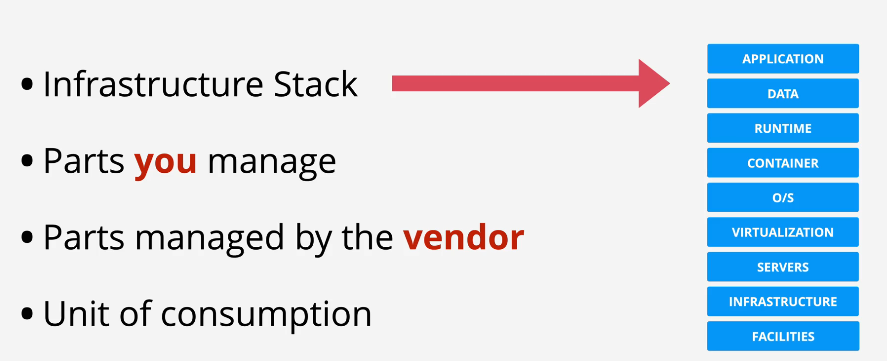
A set of interconnected components (hardware, software, networking, and services) that work together to support the deployment, operation, and scaling of an application.
With any implementation of the stack, there are parts that you manage and parts the vendor manages
Unit of consumption
It’s what you pay for and what you consume
Part of the system where from that point upwards in the infrastructure stack, you are responsible for management
Netflix → you consume the service (application) and that’s it
Deployment models
On-Premises
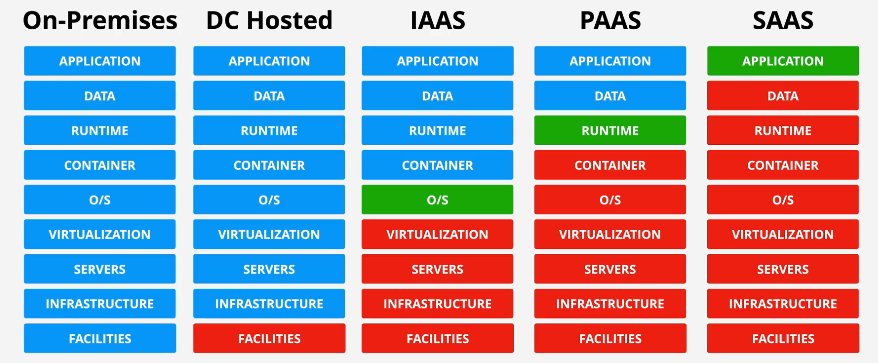
Your business buys/owns/controls all parts of the stack
Very flexible, can make systems tailored to your business
DC Hosted
Data center hosting was popular before cloud
You place your equipment inside a building owned/managed by a vendor → the facilities owned by the vendor
Now (in the modern world), we’re just handing more and more to the vendor
The costs change, the risks involved change, and the amount of flexibility change, but it’s all the same infrastructure stack
Service Models
no matter what the infrastructure stack exists in every service/application you use
for every stack
there is part of the stack managed by you and parts managed by the vendor
there is your unit of consumption (part u pay for)
Infrastructure as service (IAAS)
IaaS is the most basic level of cloud service.
Provides fundamental computing infrastructure like virtual servers, storage, and networking
like leasing a plot of land → you get the land and the utility connections (internet, power), but you have to build your own house, set up the plumbing, and manage everything inside it
Provider manages until the virtualization
you consume the operating system - you manage the OS and everything above it
great compromise -lose a lil flexibility but substantially reduce cost/risk
Example
AWS (Amazon Web Services), Microsoft Azure, and GCP (Google Cloud Platform)
Platform as a service (PAAS)
Complete development and deployment environment in the cloud
The cloud provider gives you the workbench, all the power tools (like databases, operating systems, and development tools), and the electricity. You just bring your project materials (your code) and build your application
more for devs who has an app they want to run and not worry about any of the infrastructure
unit of consumption is the runtime environment
ex. if you run a Python application, you pay for a Python runtime environment
Example
Heroku
Software as a service (SAAS)
SaaS delivers ready-to-use software applications over the internet, usually on a subscription basis. You don’t manage the software or the infrastructure it runs on; you just use it.
service itself is provided from the cloud
You consume the application and have 0 exposure to everything else