class Solution { public double findMedianSortedArrays(int[] nums1, int[] nums2) { int[] A = nums1; int[] B = nums2; int total = A.length + B.length; // int half = total / 2; int half = (total + 1) / 2; // we + 1 to make sure the median is always on the left partition // make A the shorter one if (B.length < A.length) { int[] tmp = A; A = B; B = tmp; } int l = 0; int r = A.length; // it's not A.length - 1 because i or j represents the start of the right (the "cut") // we need this to consider the case where ALL elements are in the left side (and 0 to the right) while (l <= r) { int i = (l + r) / 2; // start of ARight.. (or # of elems to put in Aleft) int j = half - i; // start of BRight (or # of elems to put in Bleft) int Aleft = i > 0 ? A[i - 1] : Integer.MIN_VALUE; int Aright = i < A.length ? A[i] : Integer.MAX_VALUE; int Bleft = j > 0 ? B[j - 1] : Integer.MIN_VALUE; int Bright = j < B.length ? B[j] : Integer.MAX_VALUE; if (Aleft <= Bright && Bleft <= Aright) { if (total % 2 != 0) { // total is odd, return the max of the lefts return Math.max(Aleft, Bleft); } else { // total is even, we get the middle (max of lefts + min of rights) / 2 return (Math.max(Aleft, Bleft) + Math.min(Aright, Bright)) / 2.0; } } else if (Aleft > Bright) { r = i - 1; } else { l = i + 1; } } return -1; }}
Concept
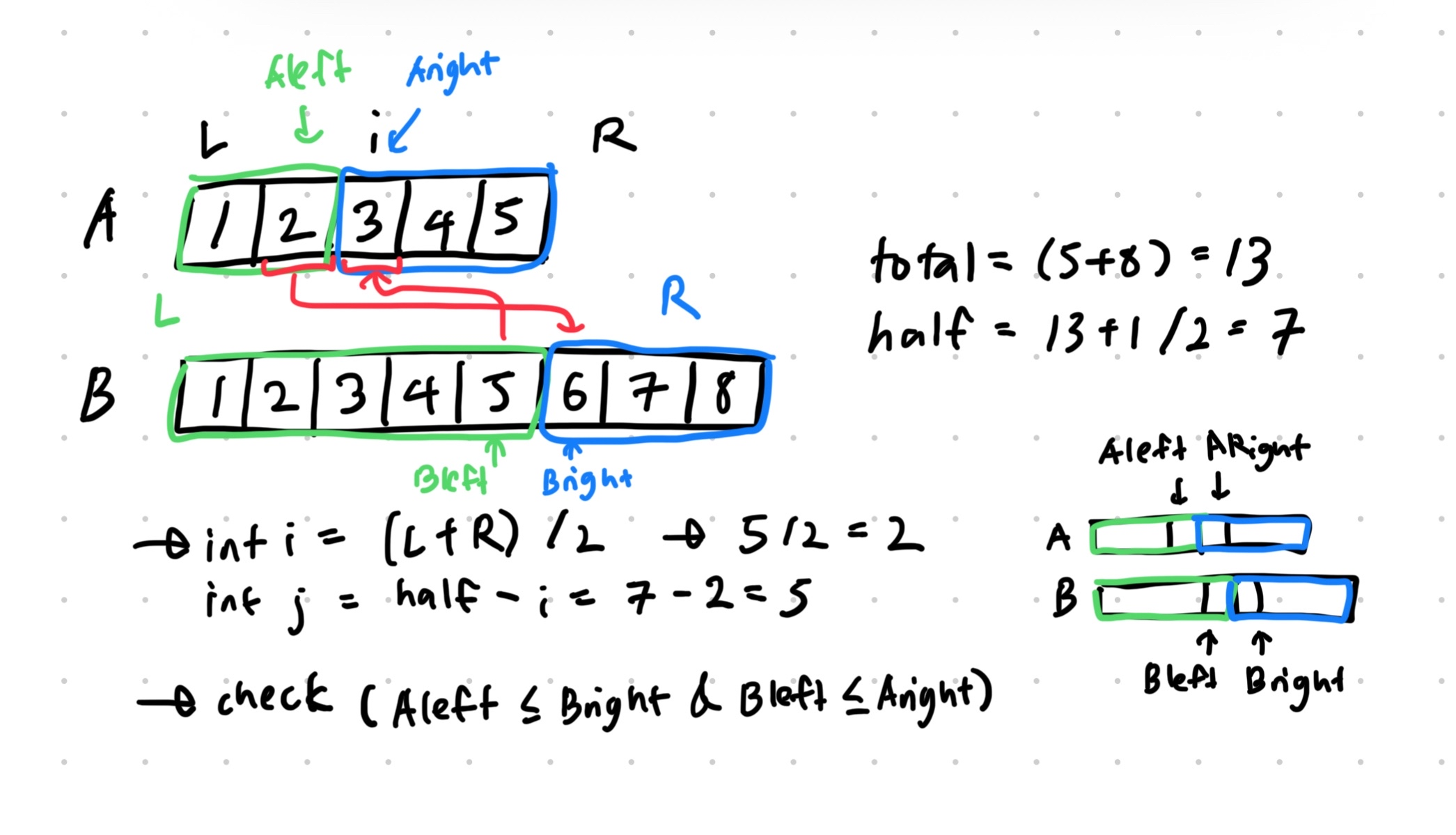
Imagine we merged those 2 arrays. We want to get the Left partition and the Right partition, then get the median.
But since we can’t merge, we need to find the partition (cut) that divides the combined set of numbers into 2 equal halves (left and right)
Strategy
The main idea is that we have a Left and Right partition, and we check Aleft <= Bright && Bleft <= Aright
If so, that means we have successfully found the left and right partition
If total is an odd number, then get Main.min(Aright, Bright)
If total is an even number, get (Math.max(Aleft, Bleft) + Math.min(Aright, Bright)) / 2
If not, if Aleft > Bright
That means when we combine all our lefts, in the left partition we have an element that is bigger than one element on the right partition
we have to shrink Aleft and expanding Bleft, so r = i - 1
else (Bleft > Aright)
That means when we combine all our lefts, in the left partition we have an element that is bigger than one element on the right partition
we have to shrink Bleft and expanding Aleft→l = i + 1
Things to note
int total = A.length + B.length;, and int half = (total + 1) / 2
we + 1 to make sure the median is always on the left partition
If total is 10, then 10 + 15/ 2 = 6 (L and R has same # of elems). If total is 11, then 11 + 1 / 2 = 6 (L has 6, R has 5).
Both cases, L is either same or larger than R, so median will always be in L
int l = 0 and int r = A.length
We do r = A.length and not A.length - 1 because we want to allow the possibility that ALL elements of A are smaller than the median (they are all Left partition and NO right partition)
If Bleft > Aright: l = i + 1 (the else case)
(Tracing example with A = [1,2], B = [3,4,5,6])
l can reach up to r, then i = (1+r)/2 can be exactly A.length, which means all of A is in the left partition
The Integer.MIN_VALUE and Integer.MAX_VALUE
We give the MIN_VALUE to the lefts and the MAX_VALUE to the rights because if they are out of bounds, when we compare the check we want it to pass
Time Complexity
The problem states that the solution must run O(log(m+n)) time.