Intro
How to query for data inside one table
- spreadsheets to dbs
- scale
- frequency
- being able to update data more frequently
- speed
- look up some info
- A database
- A collection of data organized for creating, reading, updating, and deleting
- Database Management System
- Software via which you interact with a database
- maybe a GUI or a language
- MySql, Oracle, PostgreSQL, SQLite, etc
- We will use SQLite
- Software via which you interact with a database
- SQL
- Structured Query Language
- A language via which you can create, read, update, and delete data in a db
- Query
- Writing queries - trying to ask questions
- what is the most liked post in instagram?
- is our number of daily users growing or shrinking
- Writing queries - trying to ask questions
# Open a db
sqlite3 longlist.db
# quit
.quit
Keywords
-- SELECT
SELECT * FROM "longlist";
SELECT "title" FROM "longlist";
SELECT "title", "author" FROM "longlist";

-- LIMIT
SELECT "title" FROM "longlist" LIMIT 10;

-- WHERE
SELECT "title" FROM "longlist" WHERE "year" = 2023;
SELECT "title" FROM "longlist" WHERE "year" = 2023 LIMIT 5;
SELECT "title","format" FROM "longlist" WHERE "format" != 'hardcover' LIMIT 5;

-- NOT
SELECT "title","format" FROM "longlist" WHERE NOT "format" = 'hardcover' LIMIT 5;

-- AND, OR, ()
SELECT "title","format" FROM "longlist" WHERE "year" = 2023 AND "format" = 'hardcover' LIMIT 5;
SELECT "title","format" FROM "longlist" WHERE ("year" = 2023 OR "year" = 2024)
	AND "format" = 'hardcover' LIMIT 5;

-- NULL
SELECT "title", "translator" FROM "longlist" WHERE "translator" IS NULL;

-- LIKE
SELECt "title" FROM "longlist" WHERE "title" LIKE '%love%';
SELECT "title" FROM "longlist" WHERE "title" LIKE 'the%';
SELECT "title" FROM "longlist" WHERE "title" LIKE 'P_re';

-- >, < >=, <=, BETWEEN ... AND ...
SELECT "title", "year" FROM "longlist" WHERE "year" >= 2019 AND "year" <= 2022;
SELECT "title", "year" FROM "longlist" WHERE "year" BETWEEN 2019 AND 2022;

-- ORDER BY
SELECT "title","rating" FROM "longlist" ORDER BY "rating" LIMIT 10;
SELECT "title","rating" FROM "longlist" ORDER BY "rating" DESC LIMIT 10;
SELECT "title", "rating" FROM "longlist" ORDER BY "rating" DESC, "votes" DESC LIMIT 10; -- 2 conds for tie- UPPERCASE for keywords for style
- to differentiate, to make it clear that this is a SQL keyword
SELECT- get some rows
- SQL identifiers - the double quotes around table/column names, style convention (single quotes for string names)
LIMIT- limiting number of items
WHERE- lets you filter rows
=, !=, <><>is just!=
NOT- negate a condition using
NOT
- negate a condition using
AND,OR,()- for chaining conditions
NULL- value doesn’t exist
IS NULL,IS NOT NULL
LIKE- for pattern matching, matching some string in my database, case insensitive
- Becomes powerful with operators:
%,_%- can match any character around a string I give it%love%- any string can go before and after “love” as long as love is somewhere in there%love- any string can only go before “love”the%- any string can only go after “the”- This might give titles with words like “there”
- so if you just want “the”, then you can do
'the %'to make this better designed
the%of%- can use for multiple words
_- can match any single character that I pass in with a stringP_re
- Operators
>, < >=, <=- We can use this to build ranges in our queries
BETWEEN....AND...
ORDER BY- order by some column, default is ascending (least to greatest)
ORDER BY ... ASC(default)ORDER BY ... DESC- Breaking ties → put 2 conditions
Aggregate functions
- gives 1 number based on the values in those rows
-- AVG
SELECT AVG("rating") FROM "longlist";

-- ROUND
SELECT ROUND(AVG("rating"), 2) FROM "longlist";

-- AS
SELECT ROUND(AVG("rating"), 2) AS "average rating" FROM longlist;

-- MIN/MAX
SELECT MAX("rating") FROM "longlist";
SELECT MIN("rating") FROM "longlist";

-- SUM
SELECT SUM("rating") FROM "longlist";

-- COUNT
SELECT COUNT(*) FROM "longlist";
SELECT COUNT("translator") FROM "longlist"; -- some values can be NULL

-- DISTINCT
SELECT DISTINCT "publisher" FROM "longlist";
SELECT COUNT(DISTINCT "publisher") FROM "longlist";AVG- average of some column
ROUND- round value
AS- renames column
MIN/MAXSUMCOUNT- number of rows, counts the rows that are NOT
NULL - counts duplicates
- number of rows, counts the rows that are NOT
DISTINCT
Practice
- Write a single SQL query to list the first and last names of all players of above average height, sorted tallest to shortest, then by first and last name.
SELECT first_name, last_name FROM players WHERE height > (SELECT AVG(height) FROM players) ORDER BY height DESC, first_name, last_name;WHERE height > (SELECT AVG(height) FROM players)- You can use an aggregate function to compare in the
WHEREkeyword!
- You can use an aggregate function to compare in the
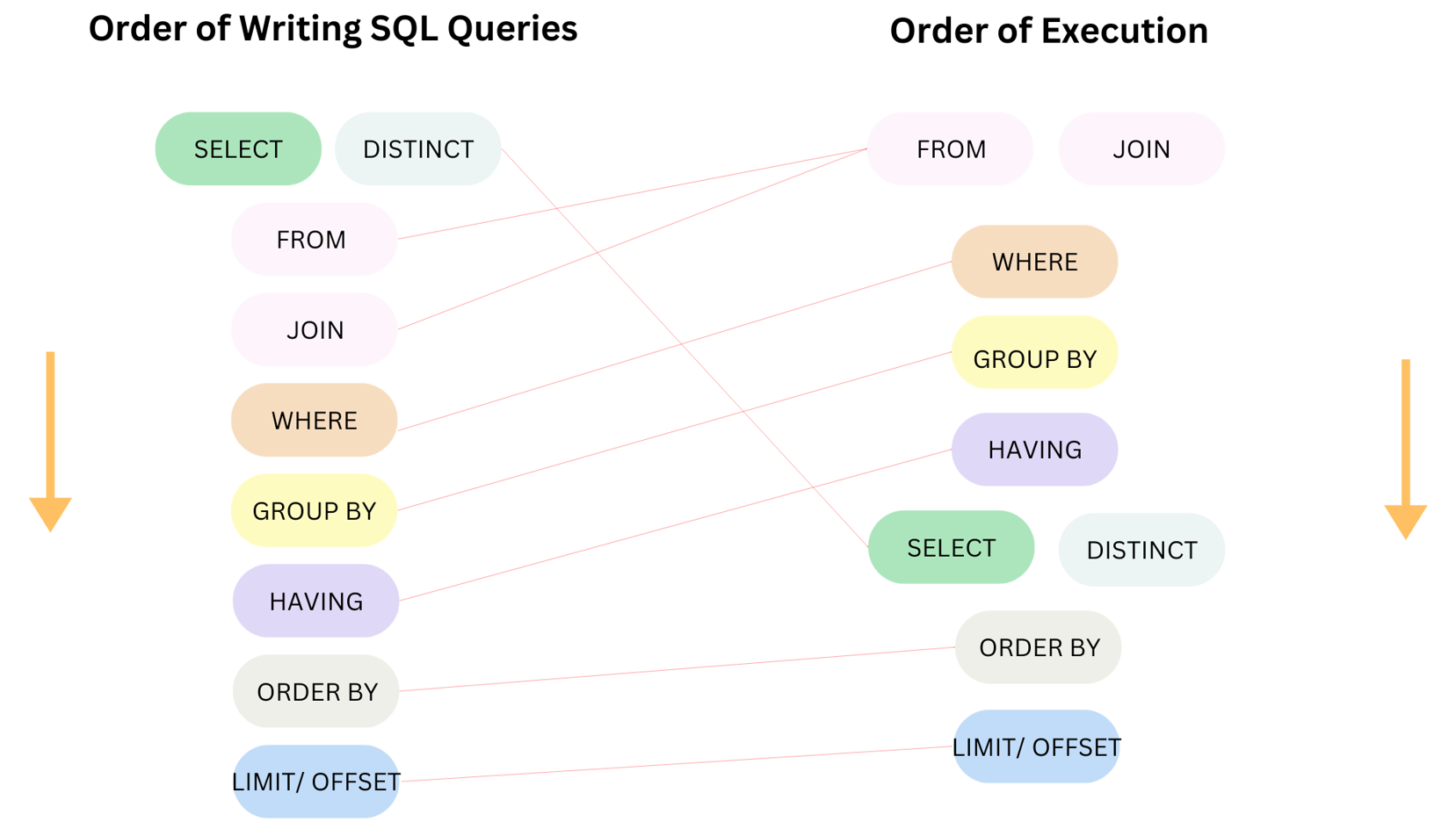
Order Of Writing / Execution